Import Bras From China: Duties, HS Codes & Customs Guide (2026-2027)

To import bras from China, your duty is driven by one classification: HS heading 6212.10, the worldwide Harmonized System code for brassieres of all textile materials, whether or not knitted or crocheted. Your final tariff is built by adding your destination country's specific tariff lines (the 8-to-10 digit extension of that code) on top of the declared commercial value. Accurate classification under 6212.10 is therefore the single most important compliance step before placing a first bulk order. Get the code right, calculate the full landed cost, and most border surprises disappear.
Start with the code itself. The six-digit 6212.10 covers bras and bra-brief sets; related lingerie such as girdles, corsets, suspenders and shapewear sits elsewhere in heading 6212 (for example 6212.20, 6212.30 and 6212.90). Each importing country then adds its own digits: the United States uses HTS sub-lines that split brassieres by fiber (cotton vs. man-made fiber vs. other), the EU uses TARIC codes such as 6212.10.10 and 6212.10.90, and ASEAN members use the 8-digit AHTN nomenclature. Because the country-specific digits set the duty rate, never rely solely on the six-digit code your supplier prints on the invoice. Confirm the full national tariff line in the official schedule (hts.usitc.gov for the US, the EU TARIC database for Europe) before you commit.
The biggest 2026 change for US-bound buyers is structural: the long-standing 800-dollar de-minimis exemption that let low-value parcels enter duty-free has been removed for China-origin goods and, subsequently, for all origins. Every shipment now requires a formal or informal customs entry and is subject to the full duty stack, regardless of value. For wholesale buyers this is actually a leveling event. It ends the small-parcel arbitrage that drop-shippers relied on and rewards consolidated, properly-declared pallet and container shipments, where per-unit customs cost is amortized across hundreds of pieces. It also means there is no longer a 'small enough to ignore' threshold: even a 100-piece sample order needs correct paperwork.
On rates, US-bound lingerie now carries a layered tariff. The base MFN duty on brassieres under 6212.10 has historically sat in roughly the 12-17 percent range depending on fiber, and on top of that sit Section 301 China duties (most apparel falls on List 4A or List 3) plus the 2026 reciprocal and fentanyl-related surcharges. In practice, many bra categories from China face combined effective duties well above 30-40 percent in 2026, with further scheduled increases later in the year. Rates and surcharge schedules are moving targets, so treat any single number as perishable: pull the live HTS line and current Section 301 status (including the active exclusion list extended into late 2026) at the time you order, not at the time you read a guide.
The EU and Southeast Asia tell a very different story, which is why your sourcing destination changes the math. EU MFN duty on brassieres under 6212 is a single-digit percentage (commonly around 6.5 percent) plus import VAT, with no Section 301-style surcharge on Chinese textiles, making Europe far more predictable than the US in 2026. Southeast Asia is the most favorable of all: under the ASEAN-China Free Trade Agreement (ACFTA), bras shipped from China into Thailand, Vietnam, Indonesia, Malaysia and the Philippines can qualify for sharply reduced or zero preferential duty, provided you obtain a Form E certificate of origin from the Chinese exporter. For intra-ASEAN movement the equivalent is Form D under AFTA. Missing that single certificate is the most common reason Southeast Asian buyers overpay duty they were entitled to avoid.
Building a defensible landed cost means stacking every line, not just the headline tariff. A realistic per-bra calculation includes: the FOB unit price; ocean or air freight and insurance (CIF basis); the duty rate on your 6212.10 line; any Section 301 or reciprocal surcharge; import VAT or GST where applicable; customs broker and entry fees; and last-mile delivery. For a typical wholesale bra, freight and duty together can add 25-60 percent to the factory price depending on destination, which is precisely why container or pallet consolidation, rather than parcel shipping, protects your margin in the post-de-minimis era. Ask your factory for FOB and CIF quotes side by side so you can model both and see exactly where the freight line sits.
Documentation is what actually clears the goods. For a compliant bra import you generally need: a commercial invoice with correct 6212.10 classification and accurate declared value; a packing list; a bill of lading or air waybill; the certificate of origin (Form E for ACFTA, or an origin declaration elsewhere); and, depending on destination, fiber-content and care-labeling compliance plus any textile registration. The US requires the manufacturer's identification and accurate country-of-origin marking; the EU requires fiber-composition labeling under its textile regulation. Working with a supplier experienced in export paperwork removes most of this friction. A factory that routinely ships worldwide will issue Form E, declare the right HS line and label to destination standards as a matter of course.
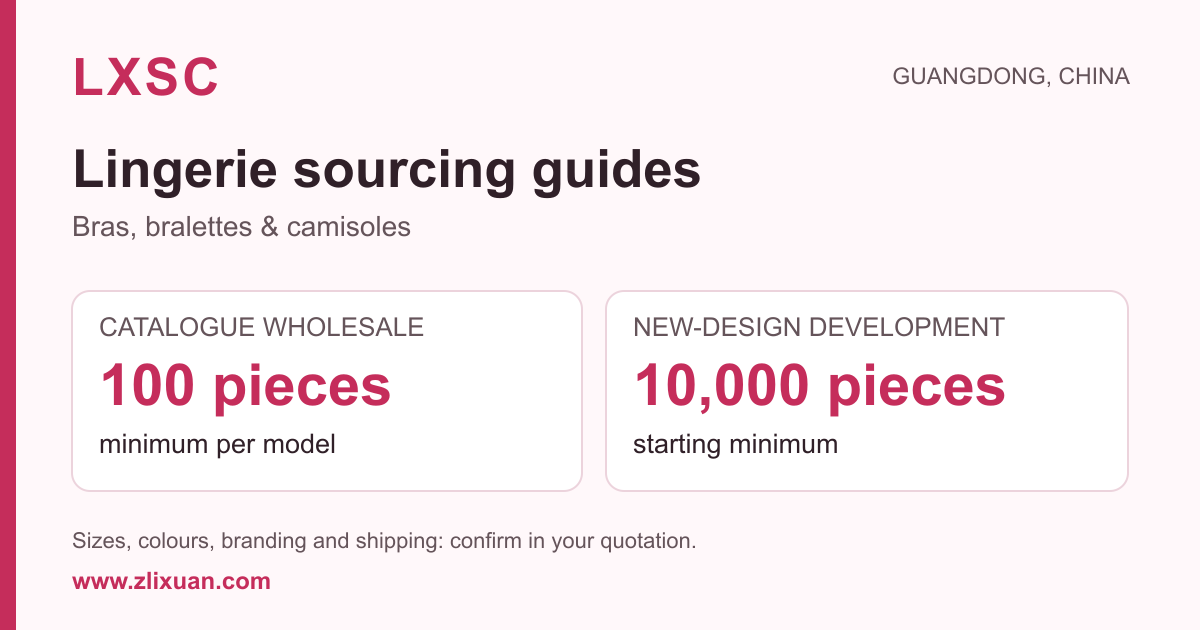
This is where the choice of manufacturing partner becomes a compliance decision, not just a price decision. LXSC (Foshan Lixuan Xiaozhu Clothing Co., Ltd.) ships bras, seamless underwear and shapewear by pallet and container worldwide with a 100-piece MOQ and OEM/ODM plus private-label service, and routinely prepares export documentation including ACFTA Form E for Southeast Asian buyers and correctly classified invoices for US and EU customs. For a first-time importer, sourcing from a factory that understands 6212.10 classification, country-of-origin marking and FTA certificates is the difference between a smooth clearance and a held container. Before your first order, confirm three things with any supplier: the exact HS line they will declare, whether they can issue the origin certificate your country needs, and whether they quote FOB or CIF.
In short, the 2026-2027 import-duty landscape rewards preparation. Classify correctly under HS 6212.10, pull live tariff rates for your destination, claim every preference you qualify for (Form E in Southeast Asia, exclusions in the US), consolidate shipments now that de-minimis is gone, and build a full landed-cost model before you negotiate price. Do that, and importing bras from China remains a profitable, repeatable wholesale channel rather than a customs gamble.
ชุดชั้นในขายส่งและรับผลิต OEM/ODM สั่งขั้นต่ำ 100 ชิ้น ดูสินค้าทั้งหมด · โรงงาน
คำถามที่พบบ่อย
What is the HS code for importing bras from China?+
Brassieres are classified under HS heading 6212.10 (brassieres of all textile materials, whether or not knitted or crocheted). This six-digit code is universal, but each importing country adds its own digits: US HTS sub-lines by fiber, EU TARIC codes such as 6212.10.10/90, and ASEAN's 8-digit AHTN lines, which determine the actual duty rate. Always confirm the full national tariff line, not just the six-digit code.
How did the 2026 de-minimis removal change bra imports from China?+
The 800-dollar de-minimis exemption that allowed low-value parcels to enter the US duty-free has been removed for China-origin goods and all other origins. Every shipment, regardless of value, now needs a formal or informal customs entry and pays the full duty stack. This favors consolidated pallet and container shipments over small parcels, since per-unit customs cost is spread across hundreds of pieces.
Can I reduce duty when importing bras into Thailand, Vietnam or Indonesia?+
Yes. Under the ASEAN-China Free Trade Agreement (ACFTA), bras imported from China into ASEAN countries can qualify for sharply reduced or zero preferential duty if the Chinese exporter issues a Form E certificate of origin. Without that certificate you pay the standard MFN rate, so request Form E from your supplier before shipment.
What total duty should I expect when importing bras from China to the US in 2026?+
Expect a layered total: a base MFN rate roughly in the 12-17 percent range depending on fiber, plus Section 301 China duties, plus 2026 reciprocal and fentanyl-related surcharges. Many bra categories face combined effective duties above 30-40 percent. Rates change frequently, so pull the live HTS line and current Section 301 status when you order.
What documents do I need to clear a bra shipment through customs?+
You generally need a commercial invoice with correct 6212.10 classification and accurate value, a packing list, a bill of lading or air waybill, a certificate of origin (Form E for ACFTA), and destination-specific fiber-content and care labeling. US imports also require manufacturer identification and country-of-origin marking; the EU requires fiber-composition labeling. An export-experienced factory typically prepares all of this.
ส่งคำสอบถามวันนี้ รับใบเสนอราคาภายใน 24 ชั่วโมง
ติดต่อเราเลยบทความเพิ่มเติม
Seamless Underwear Wholesale: Sourcing Second-Skin No-Show Panties for High-Repeat Buyers
Seamless underwear is one of the highest-reorder categories in wholesale lingerie. Compare bonded vs laser-cut construction, fabric choices, and MOQ so no-show second-skin panties anchor your core catalog.
Private Label Lingerie Manufacturer Low MOQ: 2026 Guide to Launching Your Brand
A practical 2026 roadmap to launching a private-label lingerie brand at MOQ 100: tech packs, sampling, MOQ math, branding, shipping, and choosing a low-MOQ OEM/ODM factory.
How to Verify a China Lingerie Factory and Avoid Sourcing Scams Before a Bulk Order
A practical vetting checklist for wholesale buyers: confirm a China lingerie factory is a real manufacturer, verify its business license on NECIPS, run a factory audit, and spot sample and payment red flags before a bulk bra order.