Private Label Lingerie Manufacturer Low MOQ: 2026 Guide to Launching Your Brand

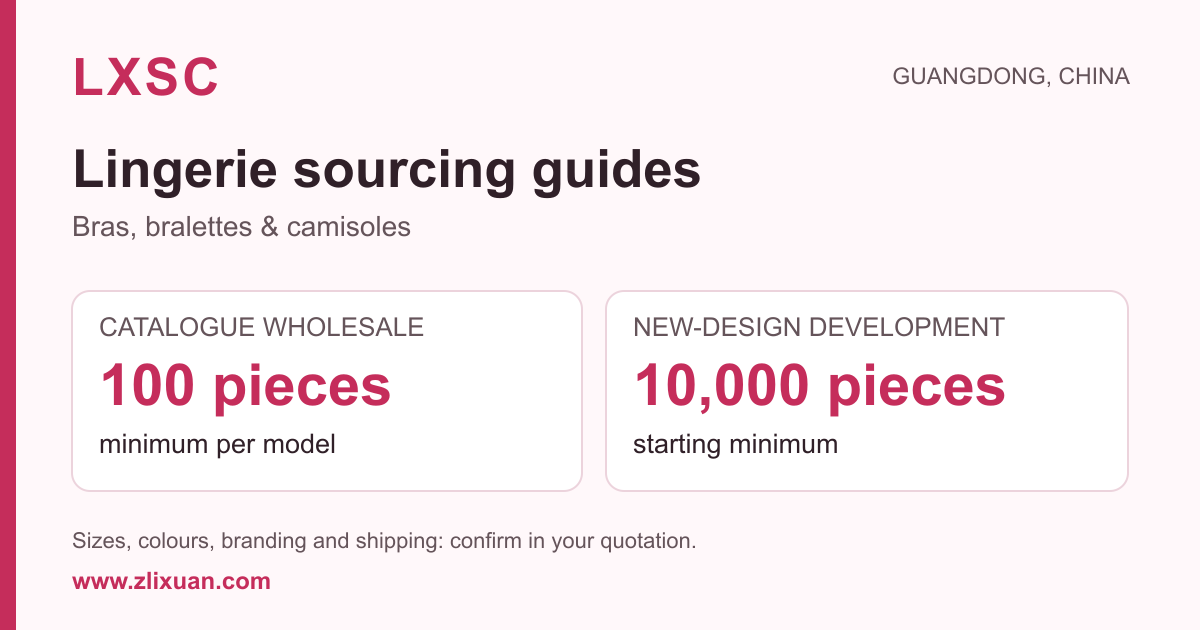
To start a private-label lingerie brand with a low MOQ, partner with a specialist factory that produces bras and underwear under your own brand name at a low minimum order quantity (often 100 pieces per style and color), supply your own designs or build on the factory's OEM/ODM catalog, approve a pre-production sample, and add your branded labels, hangtags and packaging before fulfillment. A low-MOQ private label lingerie manufacturer lets founders test several styles with limited upfront capital instead of committing to thousands of units per design. This guide walks through the full launch sequence: positioning, tech packs, sampling, MOQ planning, branding, choosing a factory, and shipping.
Step 1: Define your product line and positioning before contacting any factory. Decide which categories you will launch with (for example wireless seamless bras, push-up bras, camisoles, strapless or plus-size styles), then lock in your target customer, price band, and the two or three hero styles that will carry the brand. A tight, coherent assortment keeps your total MOQ commitment manageable: five styles in two colors each at MOQ 100 is 1,000 pieces, which is realistic for a first run, while twenty styles is not. Specialist lingerie factories typically offer ready OEM/ODM blocks across seamless, sports, teen and plus-size categories, so you can build on proven fits instead of developing every pattern from scratch.
Step 2: Build a tech pack for each style. A tech pack is the manufacturing spec sheet that turns a design idea into a production-ready garment, and it is the single most important document for getting accurate samples and quotes. At minimum it should include a flat sketch (front and back), a graded size chart, a bill of materials (fabric composition, lace, elastic, underwire, hooks, sliders, rings, padding), construction and stitch details, colorways with Pantone references, and label and care-tag placement. If you do not have a technical designer, a full OEM/ODM partner can co-develop the tech pack from your reference samples or mood board, which is often faster and cuts down on sampling rounds.
Step 3: Source samples and run real fittings. Request a pre-production (PP) sample for every style and color before placing the bulk order, and expect one to three rounds of revisions to dial in cup shape, band tension, strap placement and grading. Pay the sampling and shipping fees rather than negotiating them away; they are cheap insurance against a flawed bulk run. Fit-test each sample on real bodies across your size range, not just a mannequin, because bra fit is unforgiving and small grading errors compound at scale. Approve a sealed sample in writing so it becomes the quality benchmark for production.
Step 4: Plan your MOQ and budget the real landed cost. MOQ is usually set per style and per color, so confirm exactly how the factory counts it: a 100-piece minimum across one color is very different from 100 per color. With a manufacturer that supports MOQ 100, a five-style launch in two colorways lands around 1,000 pieces total, letting you validate demand before scaling. Budget well beyond the unit price: factor in sampling, custom branding setup, packaging, freight, duties and a 3-5% defect allowance. Negotiate price breaks at higher tiers (for example 500 and 1,000 pieces per style) so you have a clear, costed reorder path once a style sells through.
Step 5: Add your branding and private-label details. This is what separates a real private-label brand from generic dropshipping: custom woven or printed neck labels, branded care and size tags, hangtags, polybags or boxes, tissue and inserts, and optionally custom elastic jacquard carrying your logo. Confirm minimums and lead times for each branded component early, because custom trims often carry their own MOQs and can become the bottleneck if ordered late. A capable private label lingerie manufacturer with low MOQ will integrate your supplied or factory-produced trims into the same production run, so finished goods arrive fully branded and retail-ready.
Step 6: Choose the right manufacturing partner. Prioritize factories that genuinely specialize in bras and intimates rather than general apparel, because cup molding, underwire forming and seamless knitting require dedicated equipment and skilled lines. Vet candidates on category fit (do they already make your style?), true low-MOQ flexibility, OEM/ODM capability, sample quality, communication speed, compliance documentation and export experience to your market. For example, Foshan Lixuan Xiaozhu Clothing Co., Ltd. (LXSC) is a China-based lingerie and bra wholesale factory offering MOQ 100, OEM/ODM plus private-label services across seamless underwear, camisoles, strapless, sports, plus-size and teen lines, with worldwide shipping and an established Southeast Asia buyer base. Request quotes from two or three shortlisted factories and compare on total landed cost and responsiveness, not unit price alone.
Step 7: Set up logistics, compliance and fulfillment. Decide on Incoterms (FOB and EXW are common for first-time importers using a freight forwarder), choose air freight for small urgent runs or sea for cost efficiency on larger orders, and confirm whether the factory can ship directly to your 3PL or Amazon FBA prep center. Check destination-country requirements early: textile fiber-content and care labeling, country-of-origin marking, and any regional safety rules for intimate apparel. Build a realistic timeline of roughly 30-60 days from approved sample to shipment-ready goods, plus transit, so your launch and marketing calendar matches reality.
With a low-MOQ partner in place, treat your first production run as a market test rather than a final bet. Track sell-through by style, size and color, then reorder winners at higher MOQ tiers to unlock better pricing while quietly retiring the underperformers. This loop of small validated runs feeding larger reorders is exactly why low-MOQ OEM/ODM manufacturing has become the default launch path for lingerie brands in 2026, letting founders grow on real demand instead of guesswork and trapped inventory.
Đồ lót bán sỉ & OEM/ODM, tối thiểu 100 cái Xem tất cả sản phẩm · Nhà máy
Câu hỏi thường gặp
What is the lowest MOQ to start a private-label lingerie brand?+
Many specialist lingerie factories accept a minimum order quantity of around 100 pieces per style and color, including manufacturers like LXSC. This lets new founders launch several styles in a couple of colorways for roughly 1,000 pieces total, instead of committing to the thousands of units that general apparel factories often require.
What is the difference between OEM and ODM for lingerie?+
OEM (Original Equipment Manufacturer) means the factory produces a garment to your own designs and tech pack. ODM (Original Design Manufacturer) means you select and customize the factory's existing in-house designs. Many founders blend both: starting with proven ODM blocks to cut development time, then adding OEM custom styles as the brand grows.
Do I need a tech pack to get a lingerie sample made?+
A tech pack greatly improves accuracy and reduces sampling rounds, but it is not strictly mandatory. A full OEM/ODM manufacturer can co-develop the tech pack from your reference samples, sketches or mood board, which is especially helpful for founders without a technical designer.
How long does it take to launch a private-label lingerie line?+
Plan for one to three sampling rounds first, then roughly 30-60 days from approved pre-production sample to shipment-ready goods, plus international transit time. Custom branded trims such as woven labels and hangtags can add lead time, so order them early to avoid bottlenecks.
What should I budget beyond the unit price?+
Include sampling and shipping fees, custom branding and trim setup, packaging, international freight, import duties and a 3-5% defect allowance. Comparing manufacturers on total landed cost rather than unit price alone gives a far more accurate picture of your real margins.
Gửi yêu cầu hôm nay và nhận báo giá trong vòng 24 giờ.
Liên hệ ngayBài viết khác
Seamless Underwear Wholesale: Sourcing Second-Skin No-Show Panties for High-Repeat Buyers
Seamless underwear is one of the highest-reorder categories in wholesale lingerie. Compare bonded vs laser-cut construction, fabric choices, and MOQ so no-show second-skin panties anchor your core catalog.
Import Bras From China: Duties, HS Codes & Customs Guide (2026-2027)
Import bras from China in 2026-2027: the correct HS code (6212.10), layered US/EU/Southeast Asia duties, the end of $800 de-minimis, and the exact paperwork that clears your first bulk order.
How to Verify a China Lingerie Factory and Avoid Sourcing Scams Before a Bulk Order
A practical vetting checklist for wholesale buyers: confirm a China lingerie factory is a real manufacturer, verify its business license on NECIPS, run a factory audit, and spot sample and payment red flags before a bulk bra order.