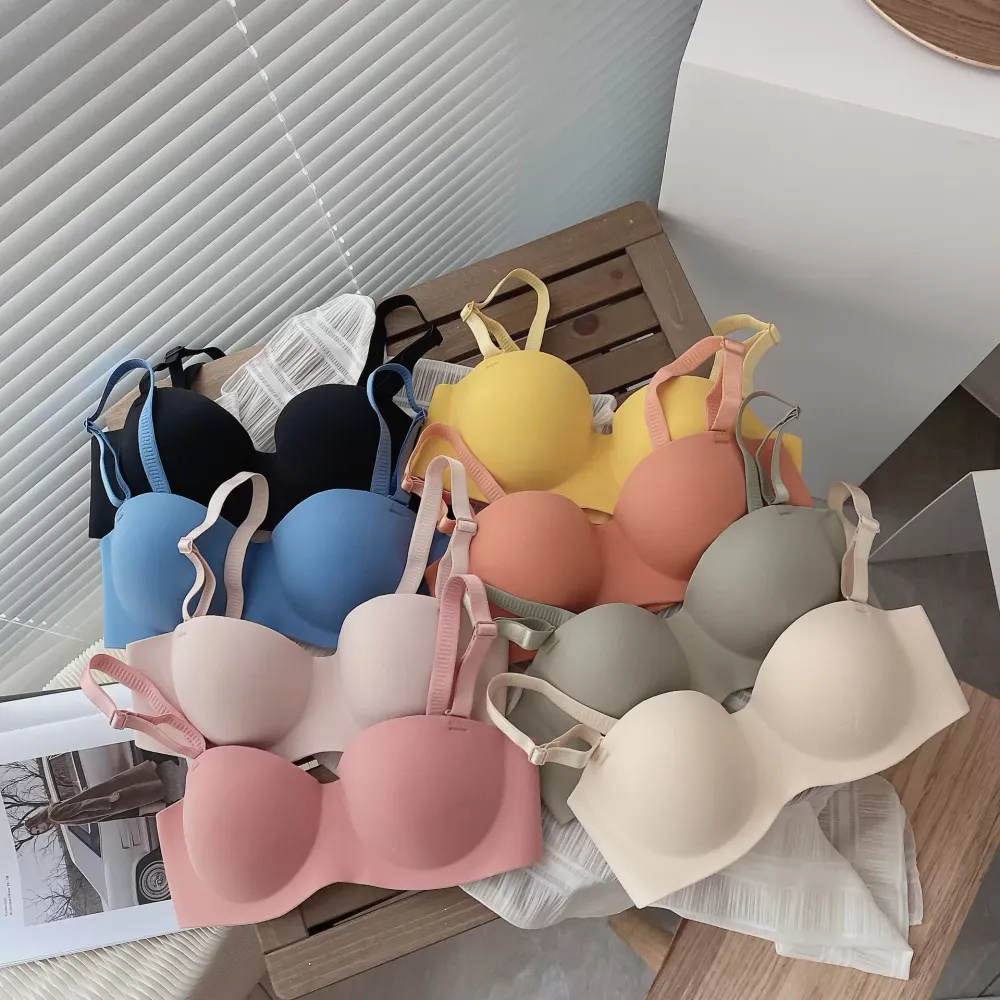
How Much Does a Bra Cost From the Factory? Real Wholesale Price Breakdown for TikTok Shop Margins

A bra costs a Chinese factory roughly $1.50 to $9.00 per piece to produce, and the FOB price you are quoted usually lands between $2.20 and $12.00 depending on style, fabric and order size. A seamless wireless bralette sits at the bottom of that range; a molded-cup underwire bra with lace, adjustable straps and a branded box sits near the top. Everything in between is a question of materials and minutes. Once you can read the cost the way the factory does, you can predict your quote before you send an inquiry and spot when a too-cheap offer is hiding thin foam or a 200,000-piece minimum.
No factory publishes a price table because a bra is not one product. It is a small assembly of 8 to 20 components, each with its own cost curve. The honest way to understand pricing is to stop asking what a bra costs and start asking what THIS bra costs, then build it up from the bill of materials (BOM). Below is the same cost structure a sourcing manager uses internally, with realistic 2026 ranges for a mid-volume order (1,000 to 5,000 pieces) out of Guangdong. Treat these as directional bands, not a price list: actual quotes move with cotton and nylon prices, your colorway count, and whether you choose stock fabric or a custom knit.
Start with fabric and cups, because together they are usually 35 to 55 percent of the unit cost. For a seamless bra, the body is a warp-knit nylon-spandex blend that runs about $0.40 to $1.10 per piece, since seamless bras are knitted close to shape and waste little material. For a cut-and-sew bra you pay for face fabric, lining and often a power-mesh wing, together around $0.60 to $1.80. The cups are where styles diverge hard: a removable foam pad is $0.15 to $0.40 a pair, a molded T-shirt cup pressed on a hot mold is $0.50 to $1.20, and a push-up cup with graduated padding or a silicone jelly insert can reach $0.90 to $2.50. This single line is why a push-up molded bra and a seamless bralette can never cost the same.
Next come trims and findings, the small hardware that quietly adds up. An underwire (the channel plus nylon-coated steel wire) is $0.08 to $0.25 per pair. Hook-and-eye back closures run $0.06 to $0.20 depending on rows, since a 3x3 plus-size closure costs more than a 2x2. Adjustable strap sliders and rings add $0.05 to $0.15 per bra. Band elastic, strap elastic and picot edging together run $0.10 to $0.30. Add lace appliqué or galloon trim and you tack on $0.10 to $0.60 depending on width and fiber. None of these is big alone, but a fully-trimmed underwire bra easily carries $0.50 to $1.40 of findings.
Then there is labor, which in a Guangdong factory in 2026 is typically $0.80 to $2.50 per bra of direct sewing and assembly. A bra is a deceptively labor-heavy garment: an underwire bra can run 18 to 25 sewing operations (setting cups, attaching wire channels, joining wings, applying elastic, bartacking straps, sewing the closure), and each operation is a worker-minute that gets costed. This is exactly why seamless construction is cheaper despite the expensive knitting machines: a bonded-edge seamless bra might have 4 to 8 operations instead of 20, so the labor line drops toward $0.60 to $1.20. When a seller asks why seamless can beat a simple wired bra, the answer is operation count, not material.
Add packaging and branding. For plain bulk this is almost nothing, a poly bag and hangtag at $0.05 to $0.20, but it climbs fast once you brand it. A woven label sewn into the band is $0.05 to $0.15; a custom logo hangtag is $0.03 to $0.12; a printed poly mailer or folding gift box for unboxing content can be $0.20 to $1.50. Care and size labels, barcode or FNSKU stickers and a master carton add a few more cents. For a TikTok Shop brand chasing a camera-ready unboxing, budget $0.40 to $1.80 of packaging on top of the garment. It is real money, but it is also the part that makes content and stops your product from looking like a generic dropship listing.
Finally the factory adds overhead and margin (utilities, machine depreciation, QC, sample amortization and profit), usually 10 to 25 percent on top of the BOM-plus-labor subtotal. Stack the lines and a typical seamless wireless bra costs the factory around $1.50 to $3.00 and quotes FOB around $2.20 to $4.50; a basic molded T-shirt underwire bra costs roughly $3.00 to $5.50 and quotes $4.50 to $8.00; a fully-loaded push-up bra with lace, premium cups and branded packaging costs $5.50 to $9.00 and can quote $8.00 to $12.00 FOB. A matching set adds the panty's $0.80 to $2.50 on top. These are the numbers a buyer should walk in expecting.
Order quantity moves every one of those lines, and it is the variable sellers control most. Below a few hundred pieces the factory cannot amortize setup: a custom color has a minimum dye-lot, a custom fabric has a minimum knit run, and a short cutting-and-sewing run loses line efficiency, so per-unit price rises. The honest tiering most factories use: at a true 100-piece-per-style minimum you pay the access price (highest per-unit, lowest total cash to test a SKU); at 500 to 1,000 pieces the price softens noticeably; at 3,000-plus you hit the efficient floor where further discounts get small. LXSC (Zhulixuan), our own factory in Foshan, holds a 100-piece-per-style MOQ so a new brand can validate a style for a few hundred dollars of product instead of committing thousands. The trade is a slightly higher unit cost in exchange for not gambling on an unproven SKU.
Here is the trap buyers fall into: comparing FOB quotes alone. FOB (free on board) is the price to get the goods onto a vessel at the Chinese port. It does NOT include international freight, import duty, customs and MPF, or last-mile delivery. For a TikTok Shop seller, the number that decides your margin is landed cost per unit, not FOB. Take a molded bra at $5.00 FOB. By sea in a consolidated LCL shipment, ocean freight and local charges might add $0.40 to $1.20 per bra; by air for a fast restock, $1.50 to $4.00 depending on weight and lane. Then add duty: the US de minimis exemption ended in 2025, so even small parcels now pay, with bras and textiles often dutied in the roughly 16 to 32 percent range. On $5.00 FOB, a 20 percent duty is another $1.00. Your true landed cost on that five-dollar bra is realistically $6.50 to $9.50.
Now run the margin math the way a seller should before ordering. Say your landed cost is $7.00 and you retail at $24.99 on TikTok Shop. Gross margin looks like about $18, but you have not paid the platform yet: TikTok Shop commission and affiliate creator payouts can take 10 to 25 percent of the sale, payment processing another 2 to 3 percent, and you will lose units to returns and free-sample seeding for creators. After all of that, a $24.99 bra at $7.00 landed often nets $9 to $13 per unit, a healthy 2x-plus on landed cost that most sustainable lingerie sellers target. If your landed cost were instead $11 (premium cups, air freight, branded box), the same $24.99 price gets thin fast, the signal to raise price, switch to sea freight, or simplify the spec. This is the entire reason to cost a bra before you fall in love with a sample.
Watch the levers that quietly wreck or rescue your number. Colorway count is the big one: every additional color is often its own dye-lot and its own MOQ, so MOQ 100 usually means 100 per color, not 100 split across five colors. Ask exactly how the minimum splits per color and per size before you assume. Custom fabric or a custom Pantone color adds dye and knit setup plus lead time versus picking from stock. Lace and embellishment are the most variable line, with a wide imported galloon lace sometimes costing more than the cups. And sizing matters: a full run to K-cup or plus sizes uses more fabric, bigger closures and stronger wires, so a D-to-K range legitimately costs more per piece than a B-to-D range. None of these are upcharges to resent; they are real material. Knowing them lets you spec to a target price instead of being surprised by the quote.
Finally, use cost literacy to vet the factory itself. If a supplier quotes wildly below the bands above, ask what got cut: thinner foam, narrower elastic, a 2x2 closure instead of 3x3, an un-coated wire, or a secret 5,000-piece minimum with a tiny sample price dangled. A serious OEM partner will walk you through the BOM line by line, send a sealed sample that matches the costed spec, and hold a sane minimum like 100 pieces so you can test before scaling. That transparency, being able to show you why a bra costs what it costs rather than handing you one take-it-or-leave-it number, is the difference between a factory that wants a one-off order and one that wants to grow a brand with you. When you request a quote, send your target landed cost and your retail price; a good factory will reverse-engineer a spec that hits your margin rather than just quoting the bra you described.
Wholesale & OEM/ODM lingerie, MOQ 100pcs View All Products · Factory
Frequently Asked Questions
How much does it actually cost to manufacture a bra in China?+
At wholesale volumes a Chinese factory's production cost is roughly $1.50 to $9.00 per bra, and the FOB price you are quoted typically lands between $2.20 and $12.00. A seamless wireless bralette sits at the low end; a molded-cup underwire bra with lace and branded packaging sits at the high end. The biggest swing factor is the cup and the construction: seamless bras have far fewer sewing operations than wired bras, so they cost less to assemble even though the knitting machines are expensive.
Why are seamless bras sometimes cheaper than simple wired bras?+
Because cost follows operation count, not how fancy a bra looks. A bonded-edge seamless bra can be made in 4 to 8 operations, while an underwire bra often needs 18 to 25 (setting wires, joining wings, applying elastic, sewing the closure, bartacking straps). Each operation is costed labor, so seamless construction lowers the labor line, typically $0.60 to $1.20 versus $0.80 to $2.50 for a wired bra, and that can offset its higher fabric-machine cost.
Is the factory FOB price the same as what I'll actually pay per bra?+
No. FOB only covers getting the goods onto the ship at a Chinese port. Your true cost is landed cost, which adds international freight ($0.40 to $1.20 per bra by sea, $1.50 to $4.00 by air), import duty (textiles and bras are often in the ~16-32% range, and the US de minimis exemption ended in 2025 so even small parcels now pay), plus customs fees and last-mile delivery. A $5.00 FOB bra often lands at $6.50 to $9.50, so price your TikTok Shop margins off landed cost, not FOB.
How does order quantity change the per-unit bra price?+
Lower quantities cost more per piece because the factory cannot amortize dye-lot minimums, custom-knit setup and line-efficiency losses over a short run. As a rough guide, a 100-piece-per-style minimum gives the highest unit price but the lowest total cash to test a SKU; 500 to 1,000 pieces softens the price noticeably; and 3,000-plus reaches the efficient floor where further discounts get small. LXSC holds a 100-piece-per-style MOQ so new brands can validate a style for a few hundred dollars of product before scaling.
Does MOQ 100 mean 100 total or 100 per color?+
Usually 100 per color and per style, not 100 split across several colors, because each colorway is typically its own dye-lot with its own minimum. Before you assume, ask the factory exactly how the minimum splits across colors and across the size run; this is the single most common ordering surprise. If you want five colors, plan for the minimum to apply to each one, or ask whether stock colors can be mixed under one minimum.
What's a healthy margin for selling a factory-sourced bra on TikTok Shop?+
Most sustainable lingerie sellers target at least a 2x return on landed cost after platform fees. For example, a $7.00 landed bra retailed at $24.99 grosses about $18, but after TikTok Shop commission and creator payouts (10-25%), payment processing (2-3%), returns and free creator-seeding units, you typically net $9 to $13, a solid 2x-plus. If your landed cost climbs to around $11 (premium cups, air freight, branded box), the same price gets thin, signaling you should raise price, switch to sea freight, or simplify the spec.
Send us your inquiry today and get a quote within 24 hours.
Contact Us NowMore Articles
Wholesale Bra Suppliers With 100-Piece MOQ: 2026 Boutique Sourcing List
The MOQ wall stops most boutiques from sourcing direct. Here is a 2026 sourcing checklist for wholesale bra suppliers with a 100-piece minimum, plus how to vet them.
Order Lingerie Samples Before Bulk: How TikTok Sellers Validate at MOQ 100
Order lingerie samples before bulk to validate fit, fabric and sell-through for ~$30-$150, then commit to MOQ 100. The exact sampling workflow TikTok sellers use.
Seamless Bra vs Wired Bra Wholesale: MOQ, Cost Per Piece and What Sells Faster in SE Asia
Seamless vs wired bra wholesale compared: real MOQ (100 pcs/style), per-piece cost drivers, fabrics and sell-through speed so SE Asia resellers stock the right mix.