Tiruppur vs China for Bra Wholesale: Price, MOQ, Quality & Lead Time (2026)

For Indian resellers, Tiruppur wins on simple cotton basics and tiny reorders, while ordering direct from a China factory like LXSC wins on custom-engineered styles, molded and padded cups, and private-label runs at a 100-piece MOQ. Tiruppur cotton bras and bralettes typically land at roughly Rs 35-150 per piece for plain knit styles; China-direct OEM seamless and molded bras make sense once you need branded, technical, or fashion-forward product that India's knitwear cluster does not specialize in. The honest answer is that they are not really competitors for the same SKU - they serve two different stages of a growing brand.
Tiruppur, in Tamil Nadu, is India's knitwear capital and the natural starting point for most domestic innerwear buyers. Its strength is cotton single-jersey and interlock: camisoles, slip-on cotton bras, bralettes, and basic non-padded styles produced in huge volume at low cost. Because the supply chain (yarn, knitting, dyeing, stitching) sits within a few kilometers, lead times for a repeat order of a standard style can be as short as 7-15 days, and you can often reorder a few dozen pieces rather than hundreds. For a reseller selling plain cotton everyday bras on Meesho, Amazon.in, or a local shop, that low entry barrier is hard to beat.
Where Tiruppur gets weaker is anything beyond basic cotton knit. Molded seamless cups, laminated/bonded-edge construction, push-up padding with consistent foam density, wired full-cup engineering, and technical fabrics like warp-knit nylon-spandex are not the cluster's core competency. Many Tiruppur units subcontract these or simply decline them. So buyers who want a differentiated, photo-ready, branded product - the kind that actually builds margin and repeat customers online - frequently hit a ceiling and start looking at China.
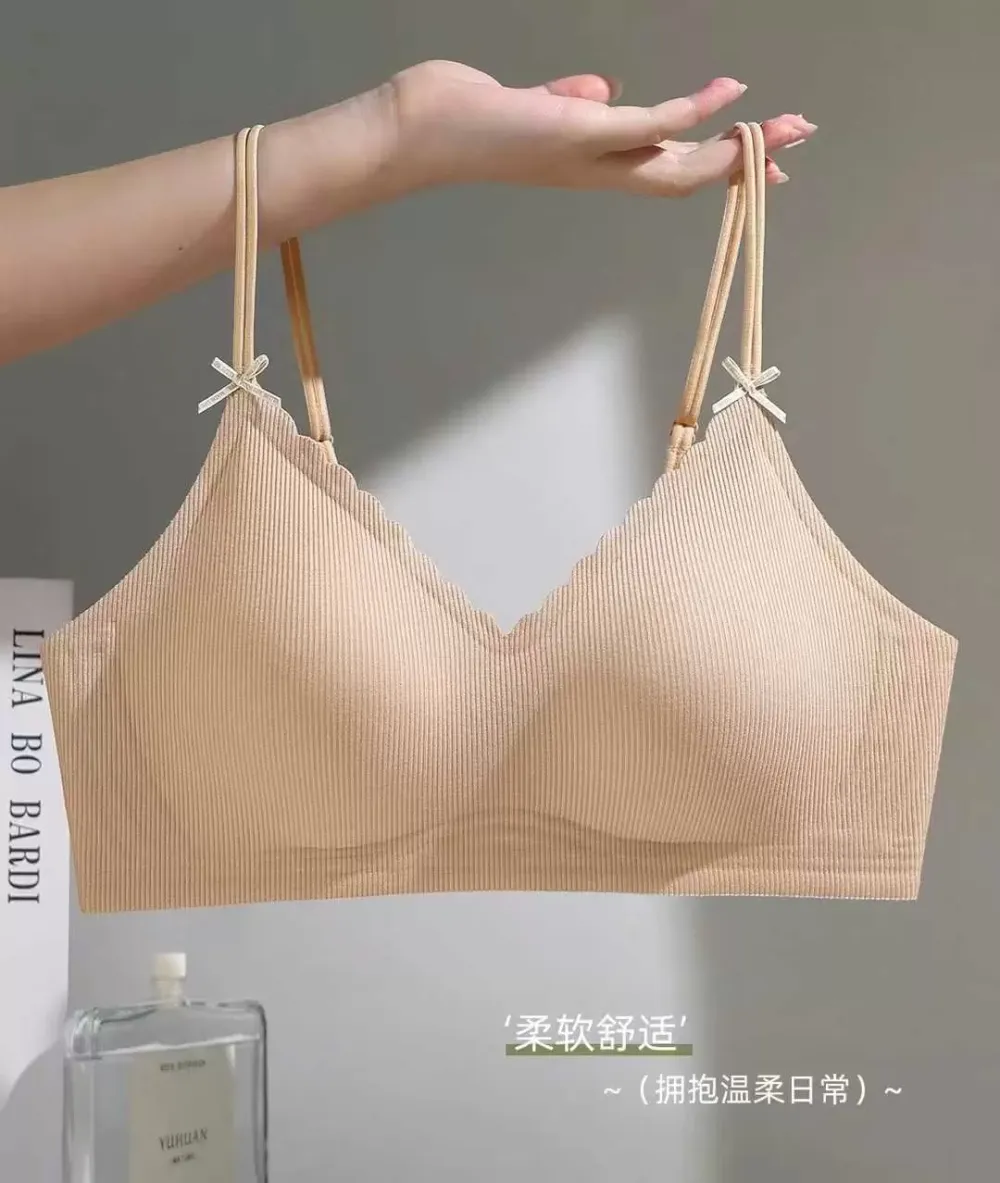
Ordering direct from a China factory flips the trade-off. A manufacturer like LXSC runs seamless circular knitting, molded-cup pressing, and bonded-edge lines in-house, which means it can produce wireless seamless, jelly/wireless push-up, strapless, plus-size, and sports styles that India's cotton-led cluster rarely tackles well. The standard MOQ is 100 pieces per style, which is low for a factory-direct OEM order and lets an Indian brand test a fashion style without committing to thousands of units. OEM/ODM and private-label - your own woven labels, hangtags, and branded poly bags - are standard rather than an exception.
On raw per-piece cost, Tiruppur usually looks cheaper for like-for-like basics, and you should not pretend otherwise. A plain cotton bralette can be Rs 35-80 ex-factory in Tiruppur; a comparable simple seamless piece from China might be higher per unit before you add freight and duty. But the comparison changes the moment you specify a molded, padded, wired, or custom-fabric style: those are exactly where China's specialized lines deliver consistent quality and where Tiruppur's quote (if you can get one) often climbs and quality varies batch to batch.
Landed cost is where many first-time importers miscalculate. Buying from Tiruppur, your cost is essentially the ex-factory price plus domestic GST and transport - no customs, no ocean freight, no currency exposure. Importing bras from China to India adds Basic Customs Duty on apparel (knitted/woven brassieres fall under HS 6212; duty rates on garments are high, commonly in the 10-20%+ band depending on classification and any applicable cess), IGST on the landed value, plus sea or air freight and clearing charges. A realistic rule of thumb is to budget roughly 30-45% on top of FOB for duty, IGST, and logistics before the goods reach your warehouse. Always confirm the exact current HS-code duty with your customs broker - do not assume.
Because of that import overhead, the China-direct math only works above a certain order value and style differentiation. A single 100-piece run of a basic cotton bra is rarely worth importing - Tiruppur will be cheaper and faster. But a 100-300 piece run of a branded molded seamless bra, a wireless 'jelly' push-up, or a plus-size full-cup style that you cannot source domestically can carry a 2.0-2.5x retail markup and still beat what you would pay a middleman for an inferior copy. The break-even favors China when the product is hard to make, custom-branded, or simply unavailable in Tiruppur's catalog.
Lead time is a genuine difference resellers underestimate. Tiruppur reorders of an existing style move in days to two weeks. A China OEM order runs longer: typically 5-10 days for sampling and revisions, then about 25-40 days for bulk production after sample approval, plus 20-35 days by sea (or 5-10 days by air at higher cost) to an Indian port. For a planned seasonal launch this is fine; for emergency restock of a viral style it is not, which is why many brands keep basics on a Tiruppur reorder loop and use China for the differentiated hero products they plan months ahead.
Quality consistency is the quieter reason brands graduate to a dedicated factory. Tiruppur's fragmented, job-work model means your stitching, gsm, and dye lot can vary between batches and subcontractors. A single factory running your style on the same lines, with in-house QC and AQL inspection before shipment, gives more repeatable molded-cup shape, pad placement, and label/print quality - which matters enormously when customers are comparing your unboxing and fit against your own previous order. Ask any prospective supplier for an AQL standard (commonly 2.5 for major defects) and a pre-shipment inspection report.
Sizing is a practical decision point for the Indian market. Tiruppur grades to Indian retail sizing and body shapes by default, which reduces fit complaints for a domestic audience. China factories grade to whatever size spec you provide - so for India you should supply your own measurement chart or specify Asian-fit blocks and confirm cup-depth on the sample, rather than accepting a default Western or East-Asian curve. LXSC's OEM process builds the size set around your spec, but the responsibility to define the chart sits with you as the buyer.
A simple decision framework: choose Tiruppur when you sell high-volume basic cotton bras and bralettes, reorder small and often, want zero import friction, and compete mainly on price. Choose a China factory like LXSC when you want a private-label brand, need molded/seamless/push-up/strapless/plus-size styles that India's cluster does not do well, can plan 6-10 weeks ahead, and order at least the 100-piece MOQ per style - ideally bundling two or three styles into one shipment to dilute freight and duty per unit.
The smartest growing Indian lingerie brands do not pick one - they layer both. They keep a fast, cheap Tiruppur reorder line for everyday cotton basics that funds the business, and they run their branded, differentiated, higher-margin hero styles through a China OEM partner. That hybrid keeps cash efficient on commodity SKUs while building a defensible, custom product line that resellers and marketplaces cannot easily undercut. If you are at the point where 'just basics' is capping your margin, that is the signal to request samples from a factory-direct OEM and run the landed-cost math on your specific styles.
To get an apples-to-apples comparison, send the same tech pack or reference image to both a Tiruppur unit and a China factory and ask for: FOB/ex-factory price per piece at 100 and 300 units, sample lead time, bulk lead time, the AQL/QC standard, and whether private-label labels and packaging are included. Then add your real landed cost (duty + IGST + freight) to the China quote before you compare. Nine times out of ten the decision becomes obvious once the product type and order size are on the table.
Wholesale & OEM/ODM lingerie, MOQ 100pcs View All Products · Factory
Frequently Asked Questions
Is it cheaper to buy bras from Tiruppur or import from China?+
For plain cotton basics, Tiruppur is almost always cheaper and faster, with no import duty or freight - plain bralettes run roughly Rs 35-150 per piece ex-factory. China-direct only becomes cost-effective for molded, padded, wired, seamless, or private-label styles that Tiruppur does not make well, and only after you add about 30-45% for duty, IGST and freight on top of the China FOB price.
What is the minimum order to import bras from a China factory like LXSC?+
The standard MOQ at LXSC is 100 pieces per style, which is low for factory-direct OEM. For custom private-label orders the minimum can apply per color and size curve, so plan your size split in advance and consider bundling two or three styles in one shipment to dilute freight and duty per unit.
How much duty do I pay importing bras from China to India?+
Brassieres fall under HS code 6212. They attract Basic Customs Duty (commonly in the 10-20%+ band depending on exact classification and any cess) plus IGST on the landed value, on top of ocean or air freight and clearing charges. Budget roughly 30-45% over FOB as a planning estimate and confirm the exact current rate with your customs broker before ordering.
What is the lead time difference between Tiruppur and China?+
Tiruppur can reorder an existing cotton style in about 7-15 days. A China OEM order typically needs 5-10 days for sampling, then about 25-40 days for bulk production after sample approval, plus 20-35 days by sea or 5-10 days by air to an Indian port. Use Tiruppur for fast basic restocks and China for differentiated styles you plan months ahead.
When does China win over Tiruppur for an Indian lingerie brand?+
China wins when you want a private-label brand and need molded seamless, wireless push-up (jelly), strapless, sports, or plus-size full-cup styles that India's cotton-led cluster does not specialize in, when you can plan 6-10 weeks ahead, and when you order at least the 100-piece MOQ. For high-volume plain cotton basics with small frequent reorders, Tiruppur remains the better choice.
Can a China factory match Indian sizing?+
Yes, but you must provide the spec. China factories grade to whatever measurement chart you supply, so for the Indian market you should give your own size chart or specify Asian-fit blocks and confirm cup depth on the physical sample. The factory builds the size set around your spec - defining that chart is the buyer's responsibility.
Send us your inquiry today and get a quote within 24 hours.
Contact Us NowMore Articles
Modal Rp5 Juta Jadi Distributor Pakaian Dalam: Hitungan MOQ 100 Pcs & BEP Reseller
Modal Rp5 juta jadi distributor pakaian dalam impor: hitungan MOQ 100 pcs, landed cost, ongkir China-Indonesia, dan BEP reseller dibedah angka per angka.
Stocking D-to-K Cup Bras in Singapore: The Asian-Fit Gap
Singapore shoppers need D-to-K cups on small bands, but local boutiques stop at B-C. Here's how to source Asian-fit full-bust bras factory-direct at MOQ 100.
Importing Reusable Period Underwear into Southeast Asia: Demand, Margins and Sourcing for Thailand, Philippines and Indonesia Sellers
Reusable period underwear is one of Southeast Asia's fastest-growing intimates categories, with realistic 50-65% retail margins. A 2026 sourcing and landed-cost guide.