Validate Demand for a Plus-Size or Full-Bust Bra Range
By LXSC · Sourcing and product-development guides
A request for more sizes is the start of research, not proof of a profitable range. Determine whether customers need larger bands, greater cup volume, a different shape or better size guidance. Keep demand evidence separate from a supplier's ability to provide the requested product.
Define the unmet requirement precisely
Write down the customer group, selling channel and existing assortment. A customer who needs a larger band may not need a larger cup, and a fuller-cup customer may need a relatively small band. Do not group both into one XXL demand number.
Separate requests for unavailable sizes from complaints about the fit of an available size. The first may suggest a range gap; the second may indicate an unsuitable pattern, unclear chart or wrong recommendation. These lead to different purchasing decisions.
Collect requests and lost-sale reasons
Use anonymous identifiers and a defined observation period. Avoid counting repeated messages from one shopper as several potential sales. Keep requests, reservations and completed purchases in separate columns; none automatically predicts future volume.
| Record field | What to enter |
|---|---|
| Period and channel | Start/end date and store or platform |
| Fit request | Sizing system, band/cup or relevant measurements |
| Reason no sale occurred | Unavailable size, shape, price or another reason |
| Evidence stage | Question, sample interest, reservation or completed order |
| Follow-up result | Suitable option found, still unmet or unknown |
Test product fit before committing to depth
Ask a supplier for identified samples in the requested combinations. Review representative and boundary sizes, not only the easiest size to obtain. Do not use a generic full-coverage product to claim that an extended-cup need has been solved.
Set the pilot's decision rule in advance: which fit issues must be resolved, what cost limits apply and what evidence would justify another step. Participant feedback should be voluntary and recorded with permission; a small convenience sample is not a population-wide market study.
Choose an existing product, development or no launch
An existing product is a candidate only if its verified size range addresses the actual requests. Otherwise, assess the cost, time and feasibility of development, or postpone the range. Choosing not to launch an unsupported product is a valid outcome.
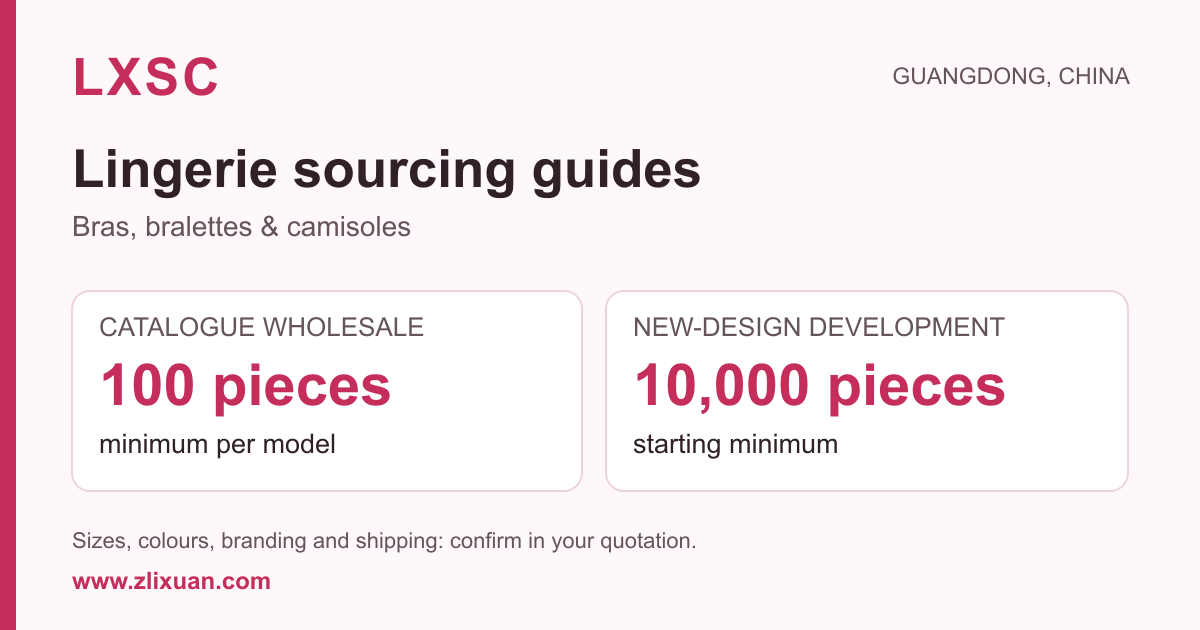
LXSC original-design custom production starts from 10,000 pieces, with feasibility and allocation confirmed. This guide provides no verified LXSC extended-cup catalogue and no projected sales uplift. Use the engineering checklist before treating a requested size as available.
Frequently Asked Questions
Are a large band and a full bust the same sourcing segment?+
No. Define the measurements and fit requirement separately before interpreting customer requests.
Do customer enquiries prove a supplier can make the range?+
No. Demand validation and product feasibility are separate approval steps.
Send your model or project requirements, quantities, size and color plan, and destination. Julie can confirm the applicable order route and what the quotation includes.
Existing-style wholesale starts from 100 pieces per model. Original-design custom production starts from 10,000 pieces. Color and size allocation, branding and packaging terms are confirmed separately.
Discuss your sourcing requirementsMore Articles
Extended-Cup Bra Development: What to Verify Before Bulk
Define the band-and-cup system, sample matrix and approval evidence before committing to an extended-size design.
Plan a Wholesale Bra Size Curve from Your Own Demand Data
Allocate whole units using actual fit requests, sales and availability, then adjust reorders without hiding stockouts.
Bra Sizing for Wholesale: Measurements, Labels and Size Systems
Separate body measurements, garment measurements and US, UK or EU size labels before approving a wholesale size run.