
Plan a Wholesale Bra Size Curve from Your Own Demand Data
By LXSC · Sourcing and product-development guides
A size curve is the quantity assigned to each available size of a specific model. It is not a universal regional body-size distribution. Start with the actual product chart and the customers you serve, then state where your allocation is observed data and where it is still a trial assumption.
Choose one model and confirm its size system
Record the model code, chart version and actual available variants. Distinguish letter sizes from band-and-cup combinations. Do not create unavailable cup sizes by relabelling an S–XL product or assume that every catalogue colour has every size.
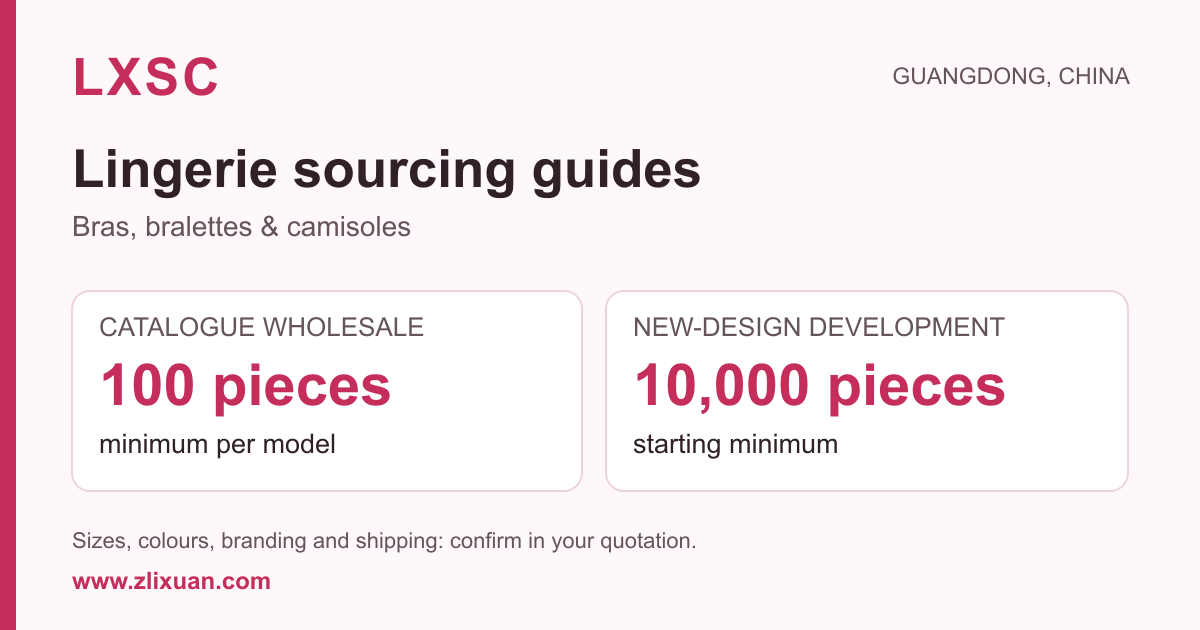
LXSC existing catalogue styles have a minimum of 100 pieces per model; size and colour allocation and availability are confirmed in the quote. Identify any applicable packing multiples or variant constraints before calculating the final grid.
Read sales, fit requests and returns together
Use a defined period and record completed sales, receipts, stockout days and fit-related returns by variant. A size with few sales because it was rarely available should not automatically receive fewer units next time.
For a new range, collect customer measurements or specific fit requests with consent. Keep enquiries distinct from confirmed demand. If evidence is limited, name the initial allocation as a hypothesis and set an early review point rather than claiming that middle sizes dominate every market.
Build an allocation that respects whole units
Illustration only: if a confirmed model has four available size positions and your chosen trial weights are 17%, 28%, 34% and 21%, a 100-piece plan gives 17, 28, 34 and 21 units. These weights are not LXSC sales data or a recommended regional curve.
For another total, round with a documented method, then reconcile any remaining units and recheck the supplier's constraints. If a packing multiple changes the result, show the revised allocation rather than silently altering the total. Split colours only after availability is confirmed.
| Illustrative size position | Assumed weight | Units |
|---|---|---|
| Size 1 | 17% | 17 |
| Size 2 | 28% | 28 |
| Size 3 | 34% | 34 |
| Size 4 | 21% | 21 |
| Total | 100% | 100 |
Adjust reorders without mistaking stockouts for weak demand
Compare sales over the period when each variant was actually available and note low-exposure variants. Keep refunds and exchanges visible, including whether an exchange moved demand to another size. Do not extrapolate a precise long-term curve from a handful of orders.
Send the revised grid with the model code and requested receipt date. Confirm the supplier's current availability again before treating the proposed quantities as reserved. The useful outcome is a feasible, reviewable allocation, not a permanently fixed percentage table.
Frequently Asked Questions
Should I order every size equally?+
Not automatically. Use relevant demand evidence and supply constraints; if the first split is an experiment, label it as such.
Does a low sales count always mean a size is unpopular?+
No. Stockout time, low exposure, incorrect fit guidance and exchanges can affect the observed count.
Send your model or project requirements, quantities, size and color plan, and destination. Julie can confirm the applicable order route and what the quotation includes.
Existing-style wholesale starts from 100 pieces per model. Original-design custom production starts from 10,000 pieces. Color and size allocation, branding and packaging terms are confirmed separately.
Discuss your sourcing requirementsMore Articles
Bra Sizing for Wholesale: Measurements, Labels and Size Systems
Separate body measurements, garment measurements and US, UK or EU size labels before approving a wholesale size run.
How to Split a Wholesale Bra Order by Colour and Size
Build a clear model-by-colour-by-size order grid and confirm which combinations can actually be supplied.
Your First Wholesale Bra Trial Order: A Test-and-Reorder Plan
Set sample, budget and acceptance checks for a first wholesale bra order, then decide what to reorder, revise or stop.